
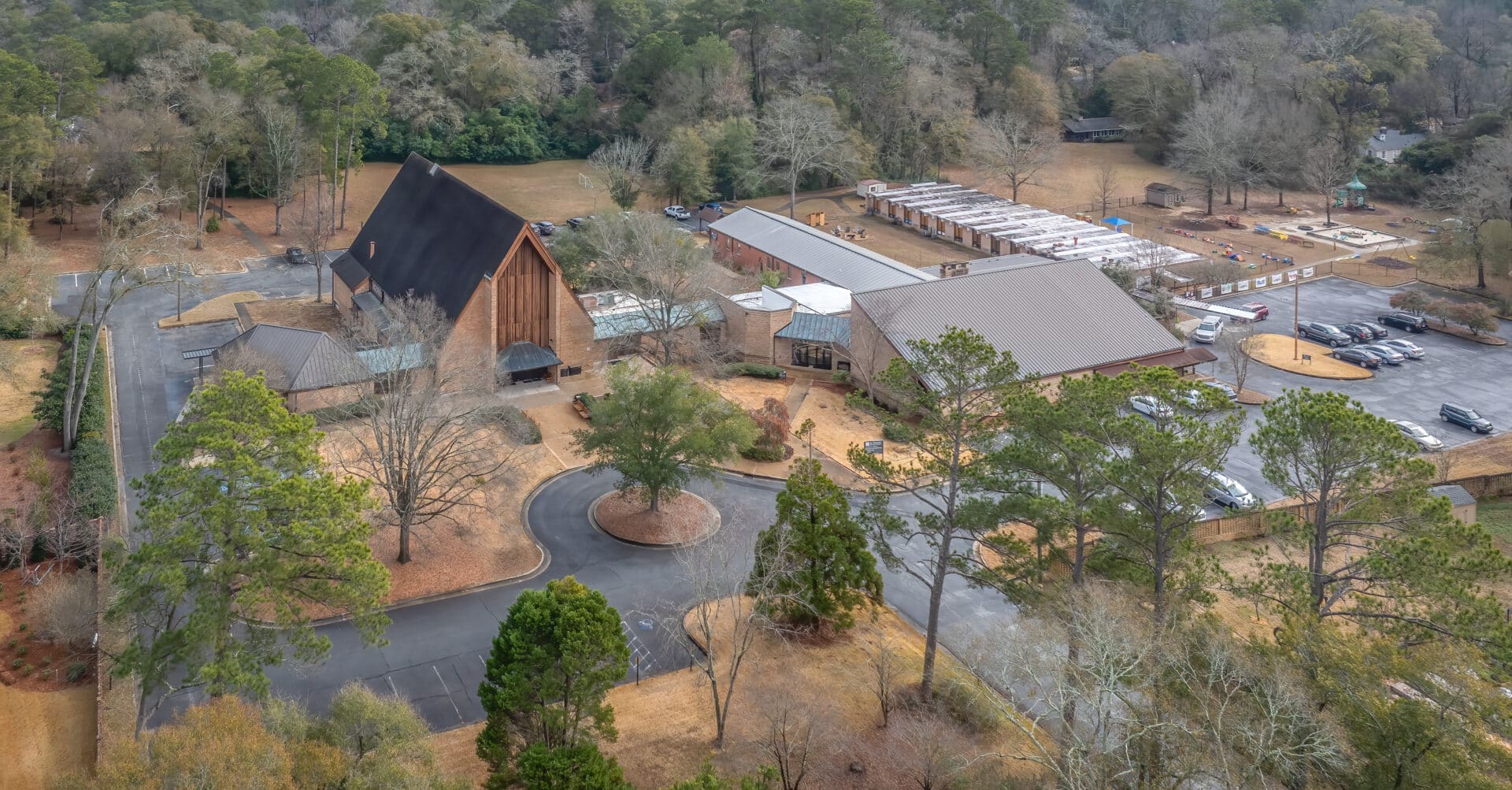
Campus Overview
Explore the St. Thomas Campus.
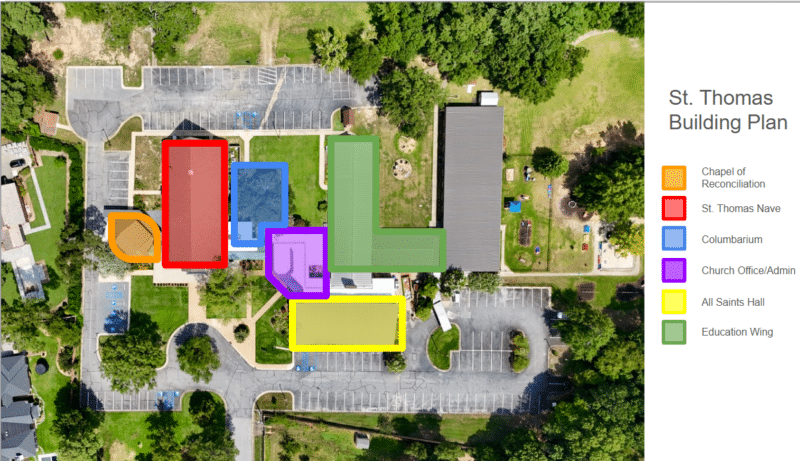
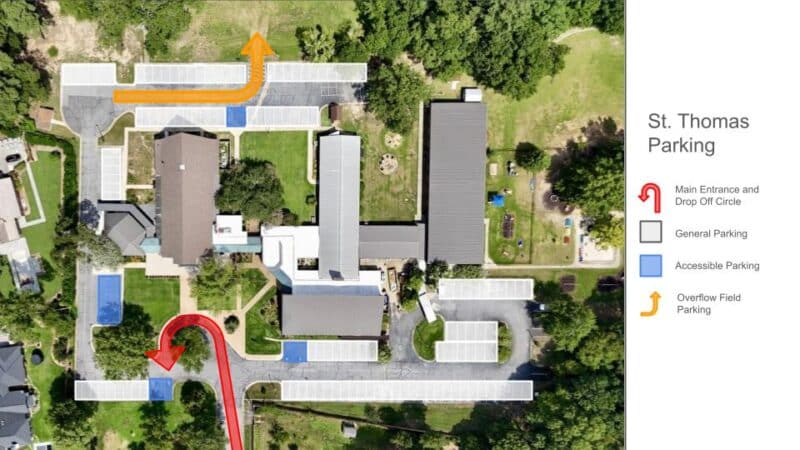
Campus Maps
Architectural Features
Nave/Sanctuary
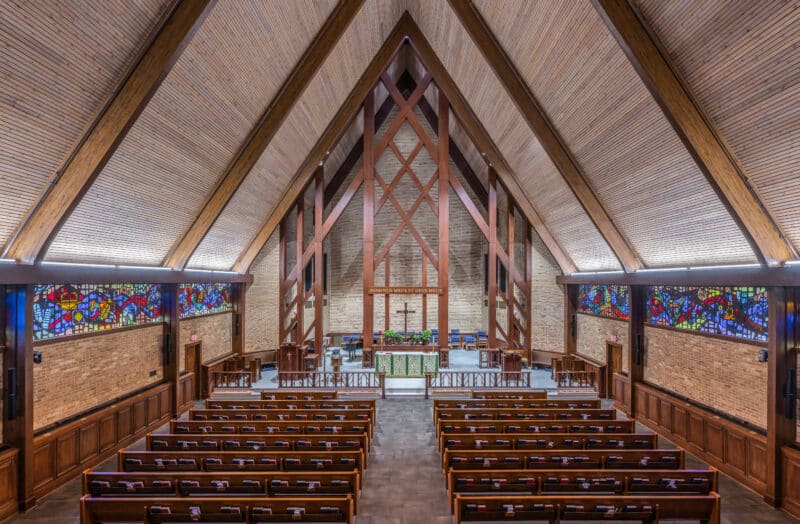
The Nave, or Sanctuary, is the heart of our worship life and a beautiful place for prayer and reflection. Every detail tells part of the story of God’s love. Above the altar are the words Dominus Meus Et Deus Meus. Latin for “My Lord and my God,” it was the joyful confession of Saint Thomas after the Resurrection. The hand-crafted needlepoint adorning the sanctuary was created by Margaret Baird, one of our beloved founding parishioners, and the stained-glass windows portray significant moments from the Old and New Testaments, inviting us to contemplate God’s saving work throughout history.
In December 2024, St. Thomas completed the Making Room for All renovation, a parish-wide effort to ensure that our worship spaces fully reflect our commitment to hospitality and inclusion. The project created step-free access to the altar rail so everyone can more easily receive the sacraments, relocated the choir to the chancel with accessible ramps for worship leaders, and transformed the former choir loft into a balcony to welcome a growing congregation. Improvements also included accessible parking near the chapel and a covered drop-off entrance, making it easier for all to enter and worship together.
This vision became a reality through the extraordinary generosity of our parish community. Seed funding from Clifford and Bobsie Swift, a transformative bequest from Joe Fischer, gifts and pledges from many parishioners, and a final gift from Judy Harding enabled the project to be completed debt-free. A plaque in the narthex gratefully recognizes all who helped make Making Room for All possible.
Chapel
Our Chapel of Reconciliation is a smaller worship space. The altar rail was made by Finley Williamson, a founding parishioner whose creative work with wood can be seen in other places in the church.
The Windows of St. Thomas
The windows, from the Willett Studios, are made of faceted glass which is chipped on the inner surfaces to give a jewel-like appearance. The brilliantly colored glass varies in thickness from one to three inches to give a three-dimensional effect in some scenes.
The stained glass windows in the nave of St. Thomas depict major scenes from The Old and New Testaments. There are six main window panels, three on each side of the nave, with each panel depicting five different biblical scenes.
The scenes run chronologically through stories of scripture. The Old Testament scenes begin with Creation and end with Daniel in the Lion’s Den, and the New Testament scenes begin with The Nativity and end with Alpha and Omega.
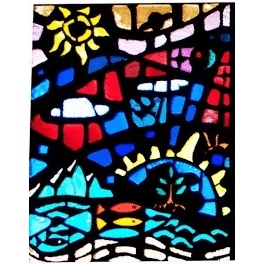
The Creation
The Old Testament begins with the proclamation that God created the heavens and the earth. So in this first panel we see the sun and planets and stars. We see birds of the air and fish in the sea. On land, we see trees and plants. The animals of the creation story link into the second scene.
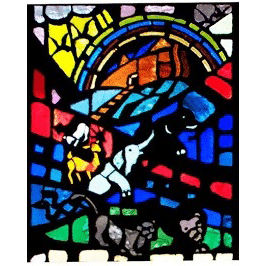
Noah’s Ark
Traveling two by two, the animals emerge from Noah’s ark. The story of Noah, the ark, and flood speaks an inspired and powerful message about judgment and grace, that has instructed God’s people throughout the ages. God’s faithfulness towards creation is represented in this panel by the rainbow that appears above the ark.
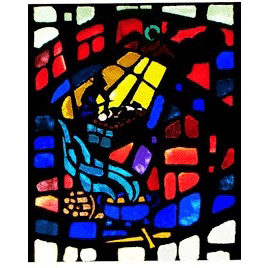
Abraham’s Sacrifice of Isaac
The story tells us that God tested Abraham by asking him to sacrifice his only son as a sign of obedience. Abraham took Isaac to a remote mountain spot, built and altar, and prepared to sacrifice him when God ordered a halt to the testing. This panel depicts the angel of God leaning from heaven to halt the sacrificial knife. The wood and the brazier of holy fire are in front.
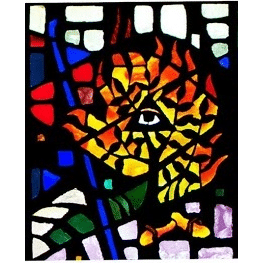
Moses and the Burning Bush
This panel depicts the account of the call of Moses at Mt. Horeb. Having earlier fled to that last of Midian from Egypt, to escape punishment, Moses was tending his father-in-law’s flocks at Horeb. He recounts his experience being called by God from out of a burning bush and ordered to go back to Egypt and bring the people of Israel out. Moses is represented by his staff and his shoes. The eye of God is shown in the burning bush.
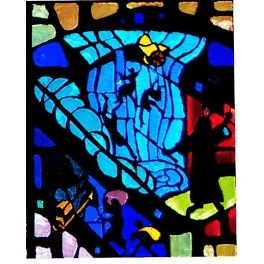
The Exodus
Moses has done as God commanded. He had gone to Pharaoh and argued for the release of God’s people. This scene shows Moses leading the people through the waters of the Red Sea. Moses is depicted as holding his staff over the water which have parted to allow the Israelites to pass. The subsequent drowning of Pharaoh’s army is represented by a tumbling chariot and falling men at the upper center of the panel.
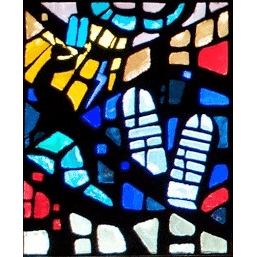
The Ten Commandments
In the book of Exodus, we read how Moses and the people finally made their way to Mount Sinai where they received the Ten Commandments from God. Moses is shown receiving the tablets in the upper left of the panel. Not long after receiving God’s law, the people violated the covenant they had made with God by worshipping a golden calf. Moses broke the tablets as a sign of this broken covenant. The tablets are depicted in broken condition in the lower right portion of the panel.
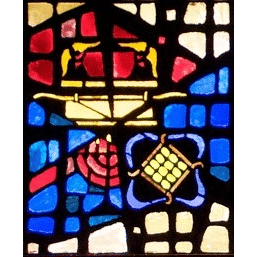
Ark of the Covenant
In this panel we center our attention to the Ark of the Covenant, which was a special box-like container within which the second set of tablets were kept and carried. Below the ark, on the right, is the breastplate of the high priest. To the left of the breastplate is the Menorah, the seven-branched candlestick.
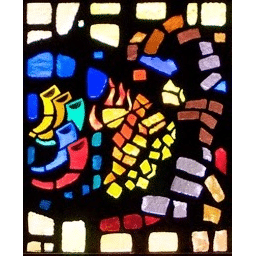
Joshua at Jericho
Needing very badly to overcome Jericho as a barrier between the people and the promised land, Joshua, led by seven priests who blew rams’ horns, was instructed to march around the city. This was done each morning for six days. On the seventh day, they completed the march around the city and gave a great shout. The walls came tumbling down. Shown in this panel are the trumpets and falling walls.
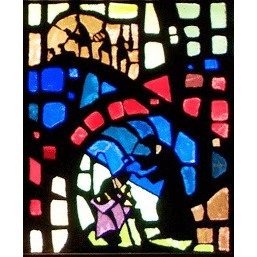
Samuel Anointing Saul
This panel depicts Saul being anointed by Samuel as the first King of Israel. When the new king departs, Samuel tells him he will meet three men: one carrying goats, one carrying three loaves of bread, and one carrying a skin of wine. These three men are shown in the upper portion of the panel.
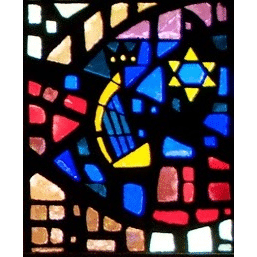
King David
We see the symbols of David, who succeeded Saul as King in this window. At the center we see the harp that David was known for playing. His crown is shown at the top center and his six pointed star to the right.
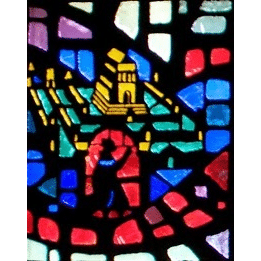
Temple of Solomon
This panel depicts the first great temple in Jerusalem. David planned this house of worship, but the work was completed by his son, Solomon. Solomon is shown kneeling at the gate of the temple.
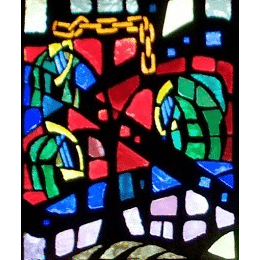
Babylonian Exile
After the strength of David and Solomon, the kingdom split in two. Eventually, the people were conquered by Babylon and taken into exile. They hung up their harps and refused to sing of their homeland. This window calls us to remember the plight of all in bondage, all who long for home.
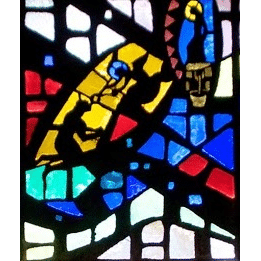
Prophet Isaiah
The Prophet Isaiah window shows the prophet receiving a burning coal on his lips as part of his call to preach. Isaiah’s vision of the suffering servant is on the right and is shown treading grapes in the winepress.
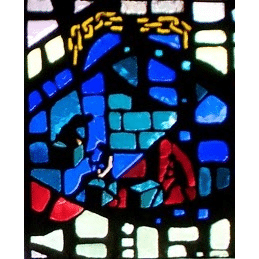
Rebuilding Jerusalem
The chains of captivity were finally broken, and the prisoners were set free and allowed to return to Jerusalem. May God continue to work with us to set the captives free.
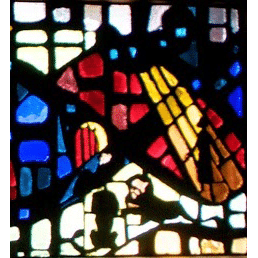
Daniel in the Lion’s Den
Daniel remained faithful in the midst of persecution. He was thrown into the lions’ den because he would not worship the king in place of God.
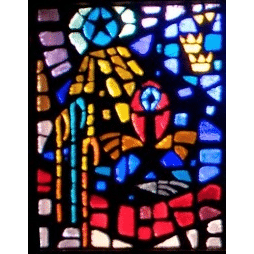
The Nativity
The infant Jesus stands in the manger with his arms stretched out to embrace the whole world, while the Star of Bethlehem shines above and shepherds and Magi gather near.
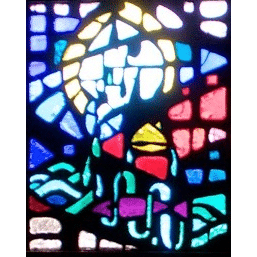
The Baptism of Jesus
When Jesus was baptized by John the Holy Spirit descended on him like a dove, sending him out in ministry to the world.
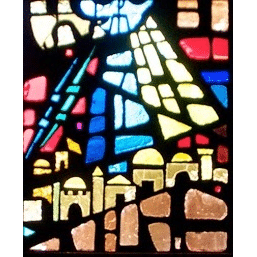
The Temptation of Christ
Immediately after His baptism, Jesus was sent into the wilderness to be tempted by Satan, represented by a serpent. Satan offered him all the kingdoms of the world in exchange for his devotion. At the bottom of the panel we see the kingdoms represented by streets and buildings.
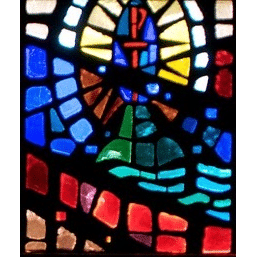
Sermon on the Mount
Jesus is represented by a Chi Rho, an ancient monogram for Christ. He speaks, like Moses, from a mountaintop to declare his law of love.
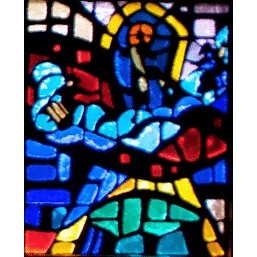
The Transfiguration
On a mountaintop, Peter, James, and John saw our Lord transfigured, his glory made visible. Moses (holding the tablets of the law) and Elijah (holding prophetic scrolls) appeared to confirm this vision.
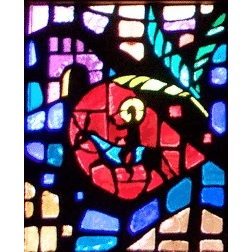
The Triumphal Entry
As our Lord entered Jerusalem to face suffering and death, the crowds welcomed him by throwing palm branches at his feet. The same crowds later cried “Crucify Him.”
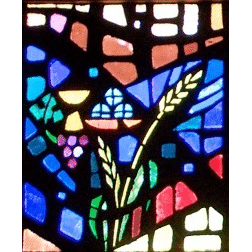
The Last Supper
The Last Supper window contains bread and wheat, grapes and wine. We share these when we gather for Eucharist.
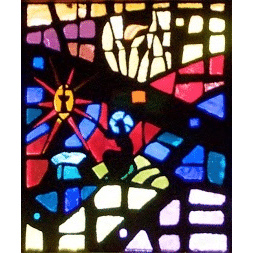
Gethsemane
In the garden prior to his arrest, Jesus asked that this cup of suffering might be taken from him, which is portrayed by the chalice at the center left. As he prayed soldiers arrived and imprisoned him. The approach of the soldiers is symbolized in the upper center of this panel by a torch and spears.
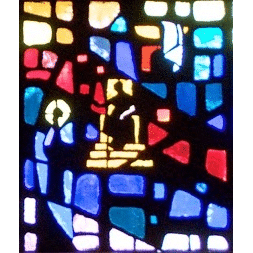
Trial Before Pilate
Though Pilate found Jesus innocent of any crime, still he washed his hands of Jesus rather than set him free. At the upper right we see the yellow basin and white towel.
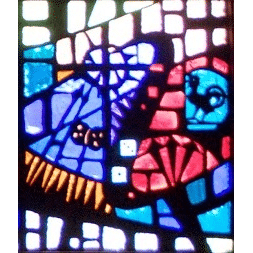
The Crucifixion
Jesus was led away to be executed. A crown of thorns was placed on his head as he was nailed to the cross. The crown is shown in red at the lower right. At the left are the spears of the soldiers and at the base of the cross are the dice with which the soldiers gambled for his robe. Shown at the lower center are the nails which pinned him to the cross, and at the right center, the cock which earlier crowed at Peter’s denial.
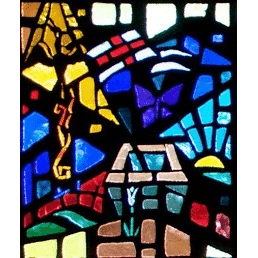
The Resurrection
The Resurrection window contains symbols of Easter – the empty tomb, the banner of Christ, mythical Phoenix, an Easter lily, a butterfly.
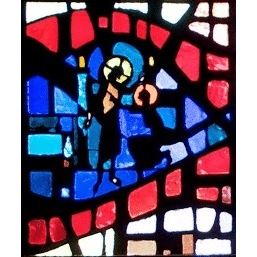
St. Thomas and the Risen Christ
After Easter, Jesus appeared to Thomas and invited him to touch his wounds. Thomas replied, “My Lord and My God.” (These words appear in Latin above our altar.) At the left center we see a table and utensils which identify the indoor setting of this Resurrection appearance.
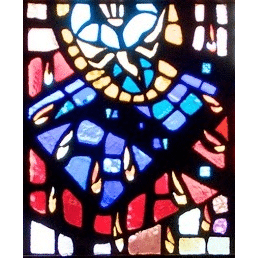
Pentecost
The disciples gathered in an Upper Room to await the coming of God’s Spirit. It arrived with the sound of a rushing wind and with tongues of fire resting on their heads and empowered them to speak the Good News of Christ to the world.
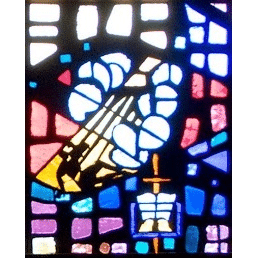
Conversion of St. Paul
Saul was on his way to Damascus to persecute Christians when he saw a vision of the risen Christ. He fell to the ground in awe. He later changed his name to Paul and became an apostle of Christ.
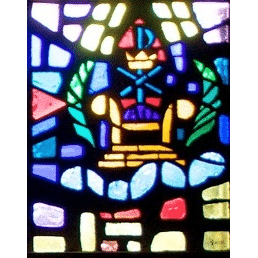
Alpha and Omega
The Revelation to John proclaims Christ as the first and last of all creation. Christ is represented by a Chi Rho, crowned on a golden throne surrounded by the green palm branches of the martyrs. This is a vision of hope, when Christ will reign victorious and all brokenness in the world will be healed.